IBN-WWT Wastewater Treatment

More Oxygen From the Air You're Already Pumping.

Overview

Most treatment plants are sitting on a hidden inefficiency, whether the process is fully aerobic or includes an anaerobic stage. In aerobic stages, a meaningful share of the oxygen plants pay to pump never reaches the biology that needs it, escaping as coarse bubbles that rise too fast to transfer. Meanwhile, fats, oils, proteins and other organic solids sit largely intact everywhere in the process, aerobic or anaerobic, too large, too insoluble, too slow to break down, placing steady pressure on aeration demand, sludge volume and nitrogen removal.

IBN-WWT doesn’t add more air. It changes what your existing aeration or circulation infrastructure does with the oxygen already there, and in the same motion, opens up the organic material that’s been throttling your process.
How It Works

IBN-WWT is a nonionic surfactant base combined with the protein component of a purified yeast extract, a processed, non-living ingredient, not a living microorganism. Together they lower surface and interfacial tension throughout the water phase. In short: this increases how much of your existing aeration actually reaches the water as usable oxygen, and it breaks down fats, oils and proteins into smaller, soluble fragments your process can use. The result is lower aeration energy per unit of organic load, less sludge, and better support for nitrification and denitrification, all from infrastructure you already have.

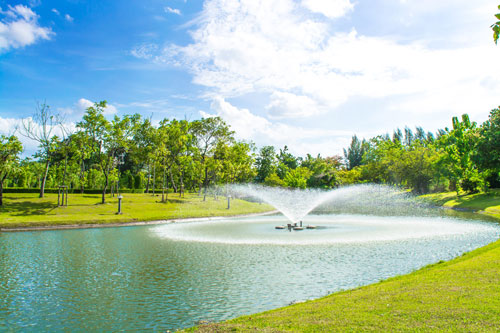
IBN Biotech Fountain Lake Management

Benefits

How Existing Oxygen Gets Used More Efficiently

With surface and interfacial tension reduced, agitation from your existing aeration or circulation equipment, the same blowers, diffusers and pumps already running, converts the oxygen already present in the water into ultra-fine bubbles. IBN-WWT doesn't generate oxygen. It transforms how efficiently the oxygen you're already paying for gets distributed. These ultra-fine bubbles carry far more surface area per unit of oxygen than the coarse bubbles they replace, and they penetrate deeper into aggregated organic material, fats, oils, grease, protein solids, exposing significantly more internal surface to the surrounding water.

How Fats, Oils and Proteins Actually Break Down

On the surface exposed by those ultra-fine bubbles, hydrolysis accelerates. Triglycerides break down into free fatty acids and glycerol, complex proteins into smaller, soluble fractions, the same molecular outcome associated with enzymatic action, but achieved through a stable, non-living physico-chemical mechanism.

Works Across Multi-Stage Plants, Anaerobic and Aerobic Alike

Many treatment plants begin with an anaerobic stage, an anaerobic lagoon or UASB reactor, for instance, before water moves into aerobic treatment. In that anaerobic stage, IBN-WWT's surface tension and hydrolysis mechanism works exactly as described, breaking down organic material into soluble fractions, without any oxygen-related effect, since none is needed or wanted there. The free fatty acids this produces feed directly into whatever anaerobic biology is present, in the same way they feed methanogenesis in a digester. Once the water reaches the aerobic stage downstream, the oxygen-transfer benefits described above take over. The same mechanism, contributing at each stage in the way that stage actually uses it.

Lowers BOD, COD and TSS, Where It Actually Counts

Solubilised, hydrolysed organic material is measured as soluble COD rather than suspended particulate load, contributing to lower TSS. Because that material becomes biologically available rather than sitting inert, BOD and COD removal across the process becomes more complete.

Supports Nitrification and Denitrification, Not Just Aeration

Nitrifying bacteria, Nitrosomonas and Nitrobacter, require a steady supply of dissolved oxygen to convert ammonia to nitrite and nitrate. By increasing oxygen availability without raising aeration demand, IBN-WWT supports more consistent nitrification performance. In anoxic zones further along the process, denitrifying bacteria need an available carbon source as an electron donor to reduce nitrate to nitrogen gas. By increasing soluble COD through hydrolysis of organic material, IBN-WWT contributes to a more consistent carbon supply for this step, supporting both halves of the nitrogen removal pathway from the same underlying mechanism.

Helps Protect Collection Systems From Sulfide Corrosion

In collection systems and lift stations, dissolved sulfide is a major driver of corrosion to concrete and metal infrastructure. Sulfide oxidises to the far less corrosive sulfate when sufficient dissolved oxygen is present. By increasing oxygen availability throughout the water column, IBN-WWT supports this chemical conversion, contributing to reduced corrosion risk in collection infrastructure.

Keeps Activated Sludge Stable in Municipal Plants

Stabilises activated sludge conditions, supports nitrification and denitrification, and reduces peak oxygen demand without expanding aeration capacity, particularly valuable where organic input is continuous and variable.

Handles Variable, FOG-Heavy Industrial Effluent

Particularly effective in food processing, dairy, rendering, and other FOG-heavy industrial streams where organic loading is variable or high.

Reduces Blockages From Grease Traps to Sewer Networks

Better hydrolysis upstream means less accumulation and fewer blockages downstream, across grease traps and sewerage networks alike.

Improves Oxygen Transfer in Lagoons and Ponds Without New Aeration

Low-infrastructure systems, aeration lagoons and stabilisation ponds included, gain more effective oxygen transfer without adding mechanical aeration capacity.

Works Alongside Membrane Bioreactors (MBR) Too

Reduced organic loading on the membrane surface supports more consistent flux and permeate quality in MBR configurations, without any change to the membrane itself or its cleaning regime.

The Same Molecular Effect as an Enzyme, Without the Downsides

No substrate-specificity limits, no cofactor requirements, no sensitivity to the pH swings or temperature extremes that deactivate biological enzymes over time. Once formed, the free fatty acids produced by hydrolysis are metabolised further by the treatment plant's own bacteria through their natural metabolism, IBN-WWT opens the door, the existing biology does the rest.

Doesn't Replace Disinfection, and Isn't Meant To

IBN-WWT supports physical and process-related conditions in water and wastewater systems. It is not intended to function as a biocidal product and does not carry biocidal claims under EU Regulation 528/2012. Use it alongside your existing disinfection and process controls, not instead of them.

Get in Touch

Not sure which solution fits your system? Contact us, or go directly to the solution for your sector above.